

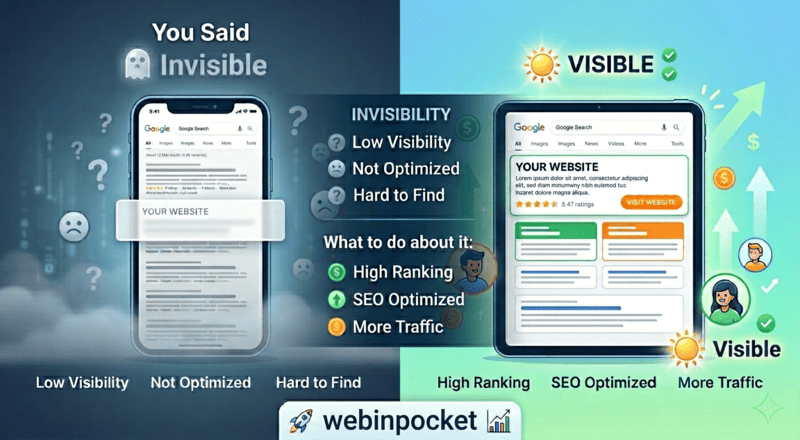
Most small and mid-size businesses in India build a website, wait a few months, and wonder why no one is calling. The answer is almost always hiding in plain sight.
We had a client a chartered accountant running a small firm in Pune, who came to us last year with a very familiar problem. He had a website. He had even paid someone ₹25,000 to build it two years ago. But when he typed “CA firm in Pune” into Google, his site was nowhere to be found. Not on page one. Not on page two. Not anywhere.
His competitor a smaller firm, with a less polished website was sitting right at the top.
This story isn’t unusual. In fact, it’s the most common situation we encounter at Webinpocket. And after working with dozens of businesses across India, we’ve learned that the reasons websites stay invisible on Google are almost always the same and almost always fixable.
Let’s go through them honestly.
You Built a Website. Google Doesn’t Know It Exists.
There’s a widespread myth that having a website automatically means Google will find it and show it to people. That’s not how it works.
Google uses bots automated programs to “crawl” the web and discover pages. But they won’t crawl your site unless you tell them where to look. If you’ve never submitted a sitemap to Google Search Console, never set up proper indexing, and never checked whether your pages are actually visible in Google’s eyes there’s a real chance your website isn’t even in Google’s index at all.
The first thing we do with any new client is check this. You’d be surprised how many businesses have been “online” for two or three years and have never been properly indexed.
Quick Check
Go to Google and type site:yourwebsite.com replacing “yourwebsite.com” with your domain. If nothing comes up, your website is not indexed. That’s step zero to fix.
Your Website Talks About You. Not About What People Are Searching For.
This one is probably the most important insight in this entire article, so read it slowly.
When you built your website, you almost certainly wrote content about your business your services, your team, your story, your values. That’s natural. But here’s the problem: nobody searches for your company name unless they already know you exist.
People search for their problems, not for brands they don’t know yet. For example, someone looking for the best web development company in Noida won’t search for “Webinpocket.” Instead, they search for terms like “affordable web developer in Noida,” “website design company for small businesses in India,” or “cost of website development in India.”
If your website doesn’t contain the actual words that real people type into Google, you will not show up no matter how beautiful your site looks.
“Nobody searches for your company name unless they already know you exist. Your website needs to speak the language of the person who is desperately looking for exactly what you offer.”
This is what keyword research solves. It sounds technical, but the idea is simple: before you write anything for your website, find out what your potential customers are actually typing into Google, and then write content that genuinely answers those searches.
The “Contact Us” Page Is Not a Content Strategy
We see this constantly. A business website with five pages: Home, About, Services, Gallery, and Contact. That’s it.
Google rewards websites that have depth that cover a topic thoroughly, that answer many different questions a user might have, that demonstrate genuine expertise over time. A five-page brochure site signals to Google that this is a thin, low-effort presence. And Google tends to treat it accordingly.
The businesses that rank well in local and national search don’t just have a services page. They have blog posts explaining how their services work. They have FAQ pages. They have case studies. They have location-specific pages if they serve multiple cities.
Every additional piece of useful content is another door through which a potential customer can find you.
- 3×:- more traffic earned by websites that blog consistently vs. those that don’t
- 75%:- of users never scroll past Google’s first page of results
- 46%:- of all Google searches have local intent “near me” or city-specific
Technical Basics
Speed and Mobile Experience: The Silent Killers
Google cares a great deal about how fast your website loads and how well it works on a mobile phone. This isn’t just about user experience – it’s a ranking factor. If your site takes more than three seconds to load on mobile, Google will push it down in results, regardless of how good your content is.
In India, where a large percentage of users browse on mid-range Android phones over 4G connections, this matters even more than in Western markets. We’ve seen businesses lose significant rankings simply because their developer added too many image carousels, used unoptimised photos, or loaded too many third-party scripts.
You can check your site’s speed right now using Google’s free tool at pagespeed.web.dev. Enter your URL and look at your mobile score. Anything below 50 is a serious problem that needs immediate attention.
The Three Most Common Speed Culprits
In our experience, slow Indian business websites almost always come down to the same three issues: uncompressed images (someone uploaded a 4MB photo directly from their phone), too many plugins if the site runs on WordPress, or cheap shared hosting that simply can’t serve pages fast enough under load.
All three are fixable. None require rebuilding the site from scratch.
Google My Business: The Most Underused Tool in India
If your business serves customers in a specific city or region, Google My Business now called Google Business Profile is arguably more important than your website itself. This is the listing that appears in Google Maps and in the “local pack” that box of three local businesses that appears at the top of many searches.
A well-optimised Google Business Profile can drive more enquiries than your entire website. Yet we regularly see businesses in India with unclaimed profiles, missing information, no photos, and zero reviews and then wondering why their competitor (who has a basic profile with 15 reviews) is getting all the calls.
Action Step
Search for your business name on Google Maps right now. If you see an “Own this business?” prompt, your listing is unclaimed. Claiming and optimising it costs nothing and can show results within weeks.
The Long Game
Why This Takes Time And Why That’s Actually Good News
Here’s something we tell every client at Webinpocket, even though it’s not always what people want to hear: SEO is not a quick fix. It’s not something you do once and then forget. It’s closer to building a reputation than running an advertisement.
But that’s also what makes it valuable. An advertisement stops working the moment you stop paying for it. Good SEO compounds over time. A blog post you write today can bring you enquiries for the next five years. A strong backlink from a reputable website today raises your credibility in Google’s eyes permanently.
The businesses we see winning in Google search especially in competitive Indian markets are the ones that started 12 to 18 months ago and kept at it consistently. They didn’t necessarily have bigger budgets. They just showed up regularly, published useful content, and stayed technically sound.
The best time to start was a year ago. The second best time is today.
A Realistic Starting Point for 2026
If you’ve read this far and you’re thinking about where to actually begin, here’s a grounded sequence that works for most small and mid-size Indian businesses:
- Claim and complete your Google Business Profile.
Add accurate hours, photos, a description with your city and services, and ask your first few happy customers to leave a review. - Check your Google Search Console.
Set it up if you haven’t. Verify your site. Submit your sitemap. Fix any indexing errors it flags. - Run a speed test and fix the obvious problems.
Compress your images. Consider a better hosting plan if you’re on the cheapest shared server available. - Rewrite your homepage and services pages
with language that matches what your customers actually search not just what you want to say about yourself. - Publish one genuinely useful blog post per month.
Not a sales pitch. A real answer to a question your customer would Google. This builds authority slowly, but it builds it permanently.
None of this is glamorous. It doesn’t involve any clever tricks or hacks. But it’s the approach that actually works consistently, across industries, across city sizes, across different types of businesses.
The businesses that are winning on Google right now aren’t doing anything mysterious. They’re just doing the fundamentals better and more consistently than everyone else.
And that, thankfully, is something any business can do.
Frequently Asked Questions
These are some of the most common SEO questions businesses face when trying to grow online. The key is to stay consistent, focus on what your audience is actually searching for, and keep improving your website over time. With the right approach, better rankings and more leads naturally follow.
- Why is my website not showing on Google
Your website may not be indexed, optimized, or using the right keywords people actually search for. - How long does SEO take to show results?
SEO usually takes 3 to 6 months to show noticeable results, depending on competition and consistency. - What is the most important ranking factor on Google?
Relevant content that matches user search intent is the most important ranking factor. - How can I check if my website is indexed on Google?
Search “site:yourwebsite.com” on Google to quickly check if your pages are indexed. - Is Google Business Profile important for local SEO?
Yes, Google Business Profile is essential for ranking in local searches and Google Maps.