

The way people search today is different from how they did a few years ago. Earlier, SEO was everything. If your website was ranking on Google, you were doing well simple as that. But now, things are changing.
A lot of users don’t even go through search results anymore. Instead, they open tools like ChatGPT, Gemini, or Claude and ask their questions directly. It’s quicker, easier, and gives them exactly what they’re looking for without extra effort.
Let’s be real most people don’t want to open multiple links anymore. They just want one clear answer. That’s why these AI tools are growing so fast. They collect information from different sources and show it in a simple, easy way.
Now here’s what many businesses are still not paying attention to. If your content isn’t showing up in those AI answers, you’re missing out on a big audience. You might still be ranking on Google, but a whole group of users won’t even see you.
This is where GEO comes in. It’s not replacing SEO, and it’s not supposed to. But it is changing how visibility works. Today, it’s not just about ranking it’s about being present wherever people are finding answers. Understanding how SEO and GEO work together is becoming important. If you want to stay relevant in the coming years, you can’t ignore this shift.
The Real Question
Should you focus on SEO, GEO, or both? Let’s break it down simply.
What is SEO?
SEO (Search Engine Optimization) is all about helping your website show up on search engines like Google. When someone searches for something, SEO decides whether your site appears near the top or gets lost somewhere no one looks.
Key goals of SEO
- Bring consistent traffic without running ads
- Rank for the keywords your audience is searching
- Make your website more visible on search results
- Build a long-term online presence
In simple terms
SEO helps people find your website on Google. It’s been working for years and is still one of the most reliable ways to grow online
What is GEO?
GEO (Generative Engine Optimization) is about creating content that AI tools can easily understand and use in their answers.
When someone asks a question to an AI tool, it doesn’t randomly answer. It looks at different sources and picks content that is clear, useful, and well-structured. GEO helps make sure your content is one of those sources.
Key goals of GEO
- Get your content included in AI-generated answers
- Build your brand presence across AI platforms
- Gain trust when your content is used as a reference
- Stay prepared for how search is evolving
In simple terms GEO
helps your content show up directly inside AI answers. Instead of waiting for clicks, your brand becomes part of the answer itself.
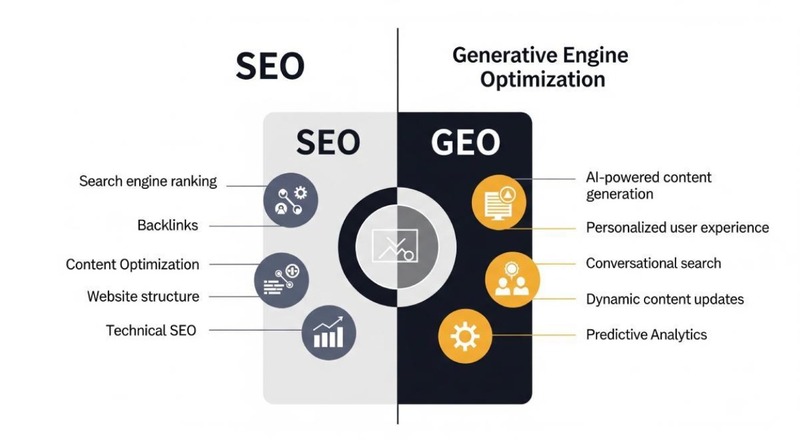
GEO vs SEO: Key Differences at a Glance
Both SEO and GEO aim for the same thing getting your brand noticed. But they work in different ways.
- SEO brings website traffic
- SEO takes time to build
- SEO focuses on search engines like Google
- SEO relies more on keywords and rankings
- GEO focuses on AI platforms like ChatGPT and Gemini
- GEO builds brand visibility through answers
- GEO relies on clear, structured, helpful content
- GEO depends more on how useful and readable your content
The Core Insight
SEO brings people to your website.
GEO builds your presence where conversations are already happening.
How Webinpocket Helps You Grow with SEO + GEO
Webinpocket works as your digital growth partner, helping businesses grow across both search engines and AI platforms.
We don’t just focus on rankings we focus on real results. Whether you want traffic from Google or visibility inside AI answers, we help you build both.
- Our approach includes:
- On page SEO
- Technical SEO
- GEO content strategy
- AI-friendly content writing
- Website development
- Performance optimization
- Lead generation systems
Common Mistakes Businesses Make
- Focusing only on keywords instead of user intent
- Writing long content that’s hard to read and understand
- Not using FAQs or structured formats
- Ignoring website performance
- Treating SEO and GEO as separate instead of combining them
The Golden Rule
Clarity + structure + useful content = visibility
This works for Google, and it works even more for AI platforms.
Conclusion
The future of search isn’t about choosing between SEO and GEO. It’s about using both together.
The businesses that grow faster in 2026 and beyond will be the ones that understand this early. They’ll rank on Google, appear in AI answers, bring in traffic, and build strong brand presence at the same time.
Frequently Asked Questions
1. What is the difference between SEO and GEO?
SEO helps your website rank on Google. GEO helps your content appear in AI-generated answers.
2. Is GEO replacing SEO?
No. GEO is not replacing SEO. Both work together.
3. Does GEO bring traffic?
It may not always bring direct clicks, but it builds trust and brand visibility.
4. Which one should I choose?
Both. SEO brings traffic, GEO builds presence.
5. How to optimize for GEO?
Use clear content, proper structure, FAQs, and simple explanations.
6. Why is GEO important?
Because more users are now relying on AI tools to search and find answers.
Ready to grow with Webinpocket?
If you want your brand to show up on Google and inside AI answers, Webinpocket can help you build the right strategy from SEO to GEO.